How Infertility and a Life-Threatening Pregnancy Changed Their Family
Interview By Brandi Fleck

Scotty and Carrie Hunt open up about infertility, postpartum healing, and answering the call that led them toward adoption.
After years of struggling with infertility, Scotty and Carrie Hunt finally received the news they had been hoping for. But their journey to parenthood was only beginning.
In Part 1 of their story, they open up about fertility treatments, losing one of their triplets early in pregnancy, welcoming premature twins, and facing a life-threatening diagnosis of postpartum cardiomyopathy just days after giving birth.
As they navigated fear, uncertainty, and the possibility that another pregnancy could cost Carrie her life, they found strength in their faith, their marriage, and the support of those around them. Those experiences would ultimately change the future of their family in ways they never expected.
Listen to Carrie and Scotty’s Interview
Watch Carrie and Scotty’s Interview
Building a Family Through Adoption
Brandi Fleck: This week's guests are Scotty and Carrie Hunt, a married couple who have been on a long journey building their family.
This is Part 1 of a two-part series in which they open up about their entire journey, from having difficulty conceiving to facing life-threatening postpartum cardiomyopathy after giving birth to precious twins, and all that entailed, such as dealing with the difficult emotions and uncertainty of the future.
Thinking that expanding their family was not a real possibility, they decided to volunteer for a church program working with underprivileged middle school-aged children. They credit this program for inspiring so much love for non-biological children. They realized the calling to adopt.
They began the process domestically, and after Carrie miraculously healed, the door opened to international adoption, leading them to their third child, a son in China.
Carrie works as an X-ray technician, and Scotty is a real estate agent in the Murphysboro area. Carrie loves reading, puzzles, volunteering, traveling, and going to museums, while Scotty loves coaching his kids' sports teams, video games, traveling, and camping.
So let's hear more about this dynamic couple who faced challenges that ultimately helped them grow together in God and as a family.
Brandi Fleck: Hi, everybody. Today on the show we have Scotty and Carrie Hunt. They're going to talk about their adoption journey. So, guys, welcome to the show. How are you doing?
Scotty Hunt: We're good. Thanks for having us.
Carrie Hunt: Good. Thank you so much for having us.
Brandi Fleck: I'm so excited for listeners to get to know you guys. Let's start a little bit by talking about how long you've been married and how many kids you have.
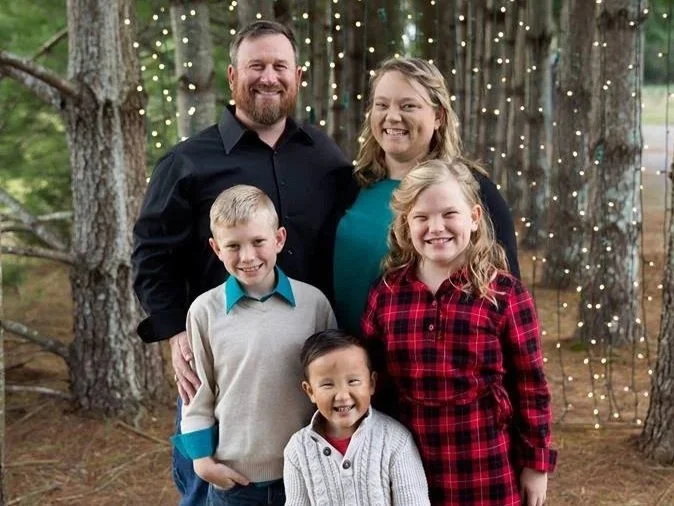
Scotty Hunt: We've been married 12 years this year. That's October. And we have three children, a boy and girl twins, Dall and Briley, and then Jordan. Jordan came to us last year, and he's adopted from China.
Brandi Fleck: Awesome. Well, congratulations on your recent anniversary.
So how did you two meet?
Scotty Hunt: We met hanging out with friends in high school. I believe it was my junior year, Carrie's sophomore year.
Brandi Fleck: Awesome. High school sweethearts.
Scotty Hunt: Yeah. I definitely knew then.
Feeling Called to Adopt
Brandi Fleck: I'm really excited to learn more about your journey creating a family, including your twins and your third son's adoption story.
Could you talk a little bit about what events you went through that led you to realize you were called to adopt?
Carrie Hunt: I think it really pressed on both of our hearts about six years ago. We started working with a group of kids through our Fortress program through church. What they do is they bring in kids in low-income housing that may not have a church or a home, and we physically go and pick them up in vans and bring them to our church.
They separate them out, and we worship with them. Our first year, it was just me, and then I kind of roped Scotty in, and we did that for three years with the middle school, pre-hormonal kids.
I think after the third year, we realized that we really wanted to adopt. We wanted to have more children, and we loved these kids so much that all that fear of not loving a child that you don't biologically carry went out the window. So that's kind of what led us to adopt.
Brandi Fleck: That's really awesome to hear. You just touched on something that I've actually heard other folks say before when considering adoption or starting a family. They've talked about that fear.
Did you guys have that before the adoption, before you went through this process? How did you work through it to that point?
Scotty Hunt: Well, there was some thought in there about that, on how would not only we react and love this child, but also our family react and love this child.
There was a lot of conversation, a lot of prayer that went along with that. Just being with the inner-city ministry, the Fortress program, helped us get over any kind of thought of that. It was there, but it was very, very minuscule.
That kind of went away with doing that because we fell in love with these kids, and they weren't even our own. We cared for them. We'd love to see them every week and watch them mature, watch them grow. That kind of helped us.
Then the part with the family, we had many conversations. We said, because of different backgrounds and things like that, not everybody accepts people the way we believe they should. So we basically said, "You know what? If they don't want to be a part of their life, they're not going to be a part of our life." We kind of just said, "You know what? We're going to do what we do," and that's what we did.
Brandi Fleck: Gotcha. Well, that makes a lot of sense.
Did you guys have conversations with your family as you were going through the process?
Carrie Hunt: Yes. Yes, lots of conversations.
I think our immediate family was first, of course. We talked to Dall and Bry and asked them what they felt, how they felt about having a sibling, how they felt about all of that. Then it kind of went down the line, you know, parents, then grandparents, and aunts and uncles.
I don't know about Scotty, but I was really surprised how supportive people would be. Scotty's family comes from a very, very tiny country town, and we were ready to go in there blazing. His grandparents hugged us and said, "We totally support you." They've been amazing through this whole thing. It took us three years, and through those three years they were always supportive. We were very, very blessed.
Supporting Families Through the Adoption Process
Brandi Fleck: That's really great to hear.
I want to sort of have a takeaway here for our listeners who maybe have a friend or family member going through a similar process. How can they support them, and what are some examples of how you were supported?
Scotty Hunt: I think the best way to show support is to go up to them and say, "We really support you and what you're doing, and we're here for you. We're here to listen. We're here to support as much as we can," whether it be financially, emotionally.
Some key points are for family members to look into the research themselves because we got a lot of false information from people that didn't know. They thought that everyone who's adopted, the mother was 16 years old, or anyone who's adopted is either a drug addict. That's not always the case.
If you go in with an open heart, a lot of times ask your own questions because we never had a problem answering questions, to a point. There are some things we don't share about our son, and that's because that's his story to tell, not ours.
To me, that would be the biggest one. And prayer. Just pray over them that each step shows them a new chapter of God, each step shows them a new chapter and strength. Each chapter just really uplifts them. I would say that would be the best way.
Carrie Hunt: Yeah, I agree.
Brandi Fleck: Okay. Well, thank you for that. That sounds really helpful.
Let's shift a little bit. I know that when you first started your family and you had the twins, Carrie, you had some health scares during that pregnancy. Can you tell us a little bit about what you went through emotionally and physically, and how it made you view life in the future?
Carrie Hunt: Sure.
We found out early on that it was going to be difficult for us to conceive. I had a condition called polycystic ovarian syndrome, and it causes a lot of ovarian issues. It causes you to have a hard time conceiving, ovulating, all that.
We found a really good doctor out of Brentwood that really listened to us and really saw that we were struggling. We started fertility treatments. We started the hormones. We had some testing to prove everything, and it was all, "Yes, you do have this."
We started fertility treatments with the hormones and everything like that. The first early-on scare was we were actually pregnant with triplets. My son was supposed to be an identical twin, and we lost that child early on.
So that kind of always puts that thought in the back of your head when you're having issues or problems throughout the pregnancy, like, "Oh, what's happening now?"
Our doctor was very, very kind, and anytime we had any questions we would talk to him directly or talk to his nurse that worked with us closely.
Later on in the pregnancy, they thought that Bry had a heart condition, which she does, but they thought that it was... With the technology of ultrasound, they were able to monitor it, and they said if she was born early that it would be a major deal.
She was born early, but thank God it wasn't a big deal. We prayed over it, and we just gave it to God.
I carried them right at 34 weeks, so that was a month early. Thank God they were delivered as big babies. He was 5 pounds 7 ounces, and then my daughter was 7 pounds 11 ounces, so she was a big girl.
Living With Postpartum Cardiomyopathy
Brandi Fleck: Okay. Did they end up in the NICU, or how did that go?
Carrie Hunt: They did not. They came down, they evaluated them, and they said, "We'll take them for like an hour in the NICU, evaluate them." They said, "Nope. They're healthy. They're good. Y'all can love them," and everything else.
We went home, and shortly after that I ended up having some shortness of breath and things like that. We found out that I had a heart disease from the pregnancy.
It's called postpartum cardiomyopathy. Mouthful.
Basically, it's where your body has a tough time carrying your child, or children in our case, and it starts shutting down your heart. It causes lots of fluid. Your body just can't process it.
Yet again, we had a great doctor that, when I told them I had shortness of breath, they said, "Come on down. Let's see what this is." They immediately got me into the hospital, and we immediately found the issue.
We were really blessed with that because, unfortunately, some people do not survive.
Brandi Fleck: I imagine that was really scary.
Carrie Hunt: It was extremely scary. For a mother to be in the hospital, and they say, "You're going to stay a while," while your children are at home, and then they tell you, "Oh, you have a heart problem."
I was 25 years old, had a healthy pregnancy. I was like, "Oh my goodness, this is happening to us."
It was really a shock, and it was emotionally a roller coaster for me.
Scotty Hunt: I know for you.
Carrie Hunt: We were really thankful we had people there, and we continued on with a cardiologist. We saw him every week. Eventually it went every two weeks after about a year, then it went on to three months, six months, and now I'm once a year.
We're really blessed. We were on nine or 10 medications starting off to help me kind of keep my heart going, and now we're down to nothing.
Brandi Fleck: That's amazing.
Is it completely gone, or is it possible that it could come back?
Carrie Hunt: Well, they suggest a few things. They suggest, "Do not get pregnant again," because if you do, we either have one or two choices. We could take the baby early, which we don't want. We've already dealt with premies and all the issues that come along with premature children. Or it could cause death for you, so we don't want that either.
So we decided at that point, at 25, to just say, "You know what? We have two beautiful children. We're good. It's not worth the risk."
Once a year they just check it to make sure that nothing's happened, and so far. I'll always be labeled heart failure, but everything is fine.
Brandi Fleck: Okay. Well, I'm sorry you had to go through that, but it sounds like some miraculous things have happened. I'm really glad to hear that everything's good.
How Medical Trauma Affects Marriage and Family
Scotty, I want to ask you, how did you feel during that time, and what did you go through as a husband and new father?
Scotty Hunt: It's a very scary time because even though my parents, or my mother and things like that, lived in the medical world, I didn't know what was going on.
She had just had the twins, so I'm in shock from that, just trying to figure out what I'm supposed to do to take care of them. We take them home, and like three days later she goes to see the doctor. They take her straight up to the hospital, admit her, and they're telling us that she's got heart failure.
They're running all these tests and everything else. I'm hearing that this could be irreversible, that she could very well die within the next six months or a year because of complications with this problem.
Because she couldn't, of course, leave the hospital, I had to coordinate everything at home with the twins. I was kind of bouncing back and forth between being in the hospital with her and my family members and her family members that were taking care of our children at home.
It was a very scary time, very stressful. Even though she had just had the twins and everything like that, it was more important to me at that point to make sure that she was okay because I entrusted my family and her family to take care of the twins and make sure that they were okay.
I spent the majority of the time at the hospital with her by her side. Then I would just kind of go home when she was sleeping or something, just to make sure that everything was going well there, and also to change clothes or get extra clothes, and then come back.
Carrie was in the hospital for... was it a week?
Carrie Hunt: Five days.
Scotty Hunt: Yeah, a week.
Basically, the first 15 days of our kids' lives were a roller coaster.
Brandi Fleck: Sounds like it.
What I'm hearing is that your family was a really strong support system and was very helpful to you. The importance of a support system is evident.
Scotty Hunt: I would say yes, very much so.
Brandi Fleck: Okay. What about healing from it? Are you both healed from that traumatic experience, and how do you know that you are?
Carrie Hunt: I think as far as healing, we've healed from it because we can talk about it. We can share it.
We give all the glory to God for seeing us through that. I think that it did take some healing and took some toll on us in the beginning. It was so stressful that sometimes the little things, having two new babies and having doctor's appointments for them and for us, it just took a toll on us.
I'm glad that we were able to be each other's support system during that time and just kind of support each other. I do think now our marriage is stronger because of it.
Scotty Hunt: I was just going to add to it. I believe we are healed from it as well.
A lot of the stress and anxiety from that did bring us closer and made us stronger. But also, just hearing that. It was seven years down the road that she was finally off the meds. That is where I was like, "Okay, we're at a place where I can see, in the future, us growing old together."
All through that time, it's very much in the back of your mind, you know, what's going to happen next? Is she still going to be there 10, 15, 20 years from now because of these complications?
Brandi Fleck: I'm really happy to hear you say that.
I was going to ask you guys before you brought it up if you think it made your marriage stronger. I think that it's a testament to how strong the relationship already was, too, because a lot of people might have fallen apart in that situation.

The Role of Faith and Prayer During Difficult Times
Do you think that the power of prayer had a lot to do with it? Could you describe faith and prayer as part of your family's journey regarding the success of these things?
Carrie Hunt: Sure.
I feel like that instance, those issues, for me brought me closer to God because we weren't as strong in faith then as we are now.
I really feel like that was a turning point in my life to turn back to God. Not saying that we were out there just sinning, sinning, sinning. It's just we didn't go to church very often then. We didn't have Bible studies. We didn't have the community of people that we do now because it wasn't as important, unfortunately, then than it is now.
I really feel like that was my turning point to start on a path that I needed to be on. Prayer became more evident in our life then, sadly, but truly. You've got to start somewhere, right? That was definitely my starting point.
Scotty Hunt: Before we even had the twins, when we were starting and everything else like that, of course we were praying through the whole process of the fertility treatments and everything like that.
But we also made the agreement that we were going to raise our children in Christ, and we were going to make sure that we found a church that was children-based so they could grow up going to classes on Sundays or Wednesdays or just being involved in a church community.
That became a very strong thing when we were bringing the twins into this world. I knew Christ from when I was younger, kind of strayed, especially during my college years, and then came back right about the time that Carrie and I got married.
Before we even got our wedding license, we met with Carrie's pastor from Clarksville, her childhood pastor, and we did classes with him. We had these tough discussions on how we were going to handle certain things and do certain things. That was kind of the starting point there.
Then it kind of just grew even more from when the twins came into our lives.
Brandi Fleck: Gotcha.
Domestic Adoption Process and Home Study Requirements
We've talked about the twins a little bit, and now let's dive into the realization that you guys mentioned earlier about being called to adopt.
What did you have to go through to get your precious third baby? I know that it was a long road, so maybe just start from the beginning and let us know what that was like.
Carrie Hunt: Well, first we started with domestic adoption.
Our first step was six months of research. We did research, we met with people who had adopted, we met with people who were adopted. We really researched our adoption agency. Were they a good one? Were they a bad one? What were people saying?
These are the people that are going to be taking care of your paperwork, that are going to be setting up appointments with birth moms and things like that. We did not want to take this lightly. We didn't want to say, "Oh yeah, let's just pick somebody out of the Yellow Pages and go with it."
We did all that first, and then we met with several different adoption agencies around middle Tennessee and really decided on which one we were going to go with.
To start off the adoption process, you have to go through what's called a home study. It's where the social worker comes to your home, and there are several things that happen. You get a background check, fingerprints. They sit down and interview you separately and together. They send out questionnaires to family and friends and people you work with to make sure that this is a family that will receive a child and raise them.
We always hear those bad stories on the Hallmark Channel about abuse, and there is legitimately that, but that's what the agency is there to do. They're there to protect you and to protect the child, which is always the upfront thing.
After that, it took us roughly about six months to get all that paperwork done, interviews and everything.
You make a book for a birth mom explaining who you are, what your core values are as a family, photos of your children, your house. Then when they have birth mothers come in, the birth mother says, "Yes, I would like my child to be raised with siblings," or, "No, I would like my child to be an only child," and then that narrows you down from the other couples.
Then you meet with the birth mom and get to know each other. They want to be able to trust you as a family to adopt their child.
Unfortunately, our path was never decided for us to go domestically. We went domestically for over a year and a half.
Then we were part of Facebook support groups. We went on a website through Facebook and saw this little boy on there. I emailed her and said, "Is this a child in the U.S.?"
With my heart issues, we never thought we could adopt internationally. She emailed me back and said, "No, he's not. He's actually in China."
I said, "Okay, thanks. Thanks anyways."
She was like, "Why don't you just try?"
What they do is they send all your information to the group in China and ask them, "Would this family be able to adopt from your country?"
We told them. We were honest. We're always honest about it. They said, "Yes, she's fine now. Not a problem."
That was a game changer for us, finding out we could adopt internationally.
We then went through the process of international adoption. We went ahead and did another home study, and that consists of kind of the same thing, but now you have to prove certain things on a national level.
For instance, I'll give you an example. One of the things is your marriage license. You take your marriage license and you go to the county. The county then puts a seal on it and says, "Yes, they were married in this county, and this is who I am" as a clerk.
Then you go to the state. The state says, "Yes, we verify that the clerk who saw their marriage certificate is a valid clerk."
Then that goes to the United States. They verify it. Then they send it over to China. China verifies everything, and then they say, "Okay, that one document is valid for us."
You do that with about 32 documents.
Brandi Fleck: Oh, wow.
Carrie Hunt: Yes. That has to do with internationally, the same thing as domestically. They want to make sure that you are a family that doesn't have any criminal records, that doesn't have anything that could hold you up in being a parent, and also you taking a child from their country and raising it as your own.
It's a very tedious process.
Afterwards, when you get your child, you end up doing follow-up home studies with your social worker. You end up having one at, I think it was...
Scotty Hunt: One month.
Carrie Hunt: One month, three months, six months, a year. After a year, you go two years, five years, 10 years.
They follow the child through this process too. At certain times they actually ask you to submit... Well, every step you submit photos of your child, updates of your child. Then when they get older, they ask for the child to write the government and say, "Yes, I'm doing okay."
They always want to know that their children who came from them are still okay.
Brandi Fleck: Gotcha, which is amazing.
Did you have any choice in the agency you went through in China? I mean, I guess since you already saw the child, he was with a certain place. How did that work?
Carrie Hunt: He was with a certain place that was, unfortunately, not our son. It turns out someone else had chosen him, and since we were not further along in the process, we were not eligible.
But you can choose your adoption agency. We chose one out of Kentucky. Unfortunately, six months into the program they had to close their China program down. There are various reasons why you would close a program down. It can be funding because those accreditations for them are very, very expensive. It can get up to $80,000 per year.
Brandi Fleck: Wow.
Carrie Hunt: That's not set by them. That's set through the different governments, and you have to provide, it's all legal stuff.
That's why they said they had to close their program down.
They then transferred all of our files and documents and everything like that over to Madison, which is another adoption agency, and we continued on our journey with them.
They have a partnership in China, so they have an office in China that does the programs for them. They had all those documents of ours in China through them.
So you can choose who you want to go through, whether it's domestic or international.
Now, some children who are on certain lists are with certain adoption agencies, but as we have grown in the adoption agency world, sometimes they'll do what's called a shared list where they say, "Okay, I see that you're going through our company, Madison. We can transfer their file to them," because their objective is to match children with families.
Brandi Fleck: That makes sense.
Choosing an Ethical Adoption Agency
One little detail I would love for our listeners to hear, if they are wanting to go through this process, is what was important about the agency that helped you decide to choose it, and what should they look for in an agency?
Carrie Hunt: I strongly suggest, when you're looking for an agency, just go out there and look at the reviews. We're living in a technology world, so it's very easy to get on there and find the good, the bad, the ugly on anything.
I strongly suggest that you do want someone who is Hague-approved. What that means is this is a world organization that says, "Yes, these people are legitimate to facilitate adoption."
The reason why you want that agency is because when you go to China, you want to have that backing that your agency is Hague-approved, too, so that it's not like the Hallmark Channel where you're, quote unquote, buying a child on the black market. Everything is done legitimately, and there's no wiggle room because, to me, that's what's very important.
We wanted to go through someone who was ethical. We also wanted to go through people that shared the same moral values as we did. I felt like Madison was one of those.
We did a lot of video conferences and phone conferences before we ever decided we were going to go with whoever we were going with.
We also, like we said, talked to people who went through their program and said, "What was your experience? Did you like them? Did you hate them? What could have made it smoother for you?"
A lot of times, when you just sit down with a person and sit down with a group of people in that company, I feel like your instincts kick in, and you get this feeling, which we believe is the Holy Spirit saying, "Yes, this is a good place to be," or, "No, there's something a little off about this."
We've met with groups that we won't mention who they are, where we were like, "There's something off."
That's what ultimately, I feel like, directed us to where we went.
Scotty Hunt: Even within the agency, when you have your counselor, the one that's taking care of you during this process and your file and everything else, you've got to be very comfortable with them as well and be able to communicate very well.
When we started our domestic adoption, it took us about six months just to interview with different agencies and find the right one that we felt comfortable with because this was the very first time we were going through all this.
We wanted to have someone that would be able to sit down with us and explain things to us and basically help us along the way so we didn't get mixed up in things.
Then, as we went from there to international adoption, the domestic agency knew the international agency and was like, "Okay, take good care of them."
We got to one that really wasn't the best, and we ended up talking to another one. Then they got shut down, and then we went to Madison.
Madison was just fantastic.
Carrie Hunt: These people also know everything about you. They know everything. When I mean everything, I mean everything about your relationship, about your work, about your life.
You have to be comfortable talking to them because they're going to ask some really tough questions together, separately, and of your family.
These people are going to be your emotional coaches too at some point because, for an example, we had one of the federal agents call my phone personally because I didn't sign in blue ink. They denied it. They said, "Nope. Blue ink only."
They said, "If you can't send this one document to us in 24 hours, we're going to deny your adoption."
Brandi Fleck: Oh, wow.
Carrie Hunt: You can imagine how I felt.
Of course, when he went down the line to talk to people and leave messages because he couldn't get anybody, they ended up being a little bit better, but mine was the first one, so of course I got all of that.
Calling your social worker in tears. You have to be comfortable with these people because they're going to end up being in your life.
We've had amazing people along the way in our life that we thank for making us a family.
Brandi Fleck: You guys, what an amazing story of growth and healing and love.
You've just got to hear more, so make sure you come back next week for Part 2, where Carrie and Scotty deliver even more heartfelt details about this amazing journey they're on.
Join the conversation!
Feel free to share your own experience and let me know if you have any questions in the comments.
Related Posts





Hi, I’m the founder of Human Amplified. I’m Brandi Fleck, a recognized communications and interviewing expert, a writer, an artist, and a private practice, certified trauma-informed life coach and Reiki healer. No matter how you interact with me, I help you tell and change your story so you can feel more like yourself. So welcome!
Find More on the Blog
Topic
- ADHD
- AI
- Atlanta
- Black and BIPOC
- DIY
- FAQ
- LGBTQIA plus
- Los Angeles
- Nashville
- Seattle
- St Louis
- St. Louis
- UFOS/UAPs/ETs
- abuse
- accountability
- addiction and recovery
- adoption
- affirmations
- afterlife
- altered state
- angels
- animals
- anxiety management
- art
- astrology
- atlanta
- attachment
- awakening
- beauty
- behind the scenes
- being human
- body image
- body work
- boundaries
- brandi fleck
- breathwork
- bullying
- burn out
- burnout
- cancer
- career
- caretaking
- chakras
- channeled
- clarity-dive
- clarity-practice
- clarity-primer
- clean products
- coach
- codependency
Recent Blog Posts
Visit the Full Podcast Audio Archive

Affiliate