
How Art Helps Us Understand the Human Experience
Interview By Brandi Fleck
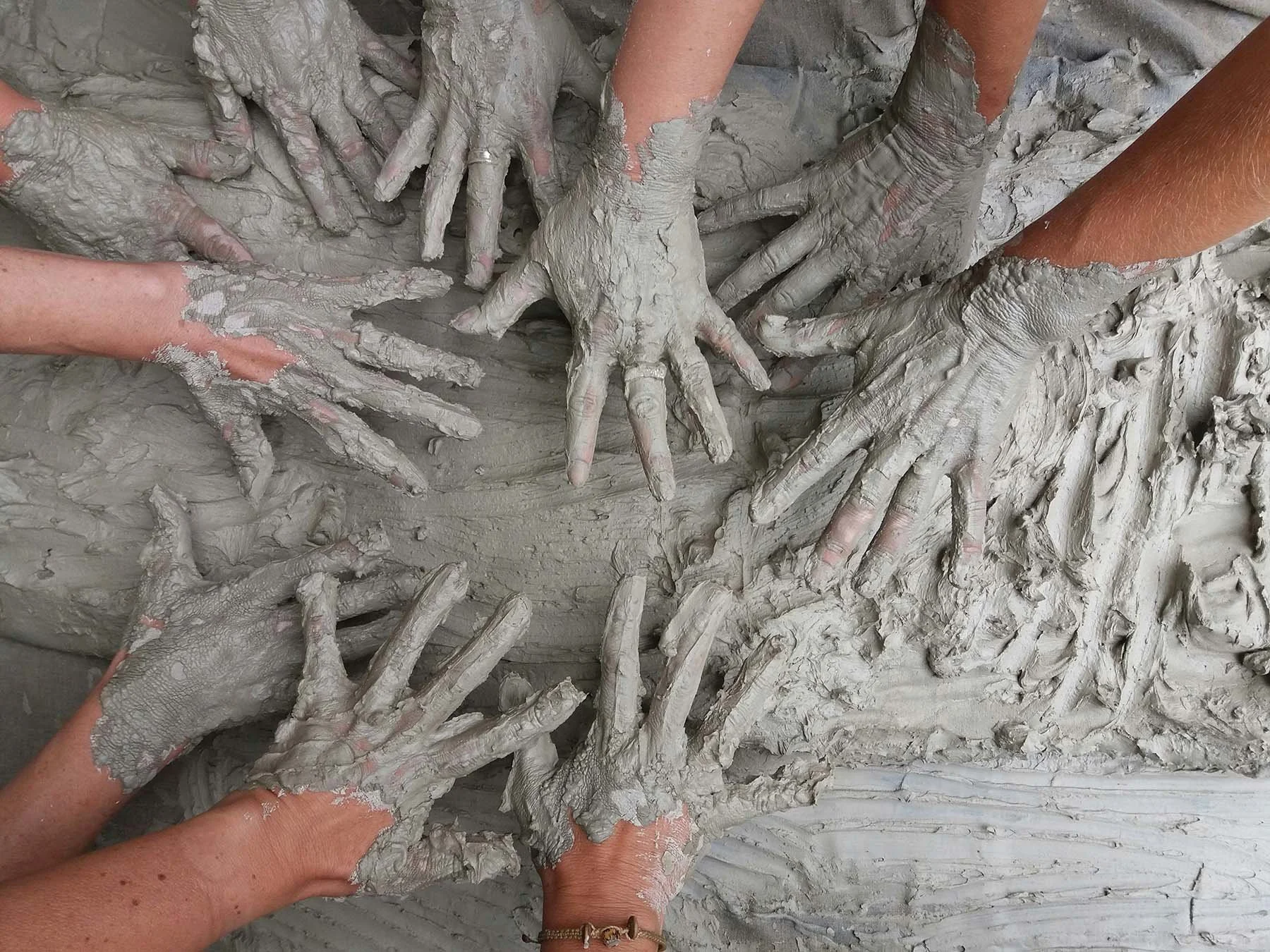
Sculptor Ben Minnis explores how creativity, nature, and art reveal identity, deepen human connection, and help us better understand ourselves.
What if creating art isn't about making something beautiful, but about discovering something true?
For sculptor Ben Minnis, every piece begins as a conversation. Rather than forcing clay into a predetermined form, he listens, responds, and lets the work reveal itself.
That process has led him to explore some of life's biggest questions: identity, human connection, creativity, childhood, and what it means to truly see another person.
Ben shares how overcoming a lifelong stutter, working with young children, and embracing uncertainty transformed not only his artwork but his understanding of what it means to be human.
Listen to Ben Minnis’ Interview
Watch Ben Minnis’ Interview
Finding Inspiration in Nature and Human Connection
Ben Minnis: Well, being human, I guess even being able to ask that question to yourself is a bit of a sign that you're in the human sphere.
To me, it's about being able to take a step back, step beyond the immediate, and be able to wonder about the possibilities and the connections and relationships between things around you. I think that avenue of our thought is what sets us aside and makes us human.
Brandi Fleck: I feel like we're living in pretty bizarro times with the recent coronavirus scare that's sort of a global problem. Also, locally, we just had a tornado rip all the way from Nashville to Cookeville, which is about 60 miles, and it left a lot of devastation in its wake.
In times like these, it's really nice to see everyone banding together to heal, pick up the wreckage, and make the best of a bad situation. I'm really proud of my local community.
With that in mind, one way to process major events like this in our lives is through the creation of art, the viewing of art, and the ability to have a commentary through visual arts. Today's guest does just that.
We're now going to hear from Ben Minnis, a sculptor from Eugene, Oregon.
Ben, welcome to the show today. I am so excited to have you here. We've known each other for quite a while, and I was so happy to see that you have started sculpting and selling your art. It's great to have you here.
How are you doing today?
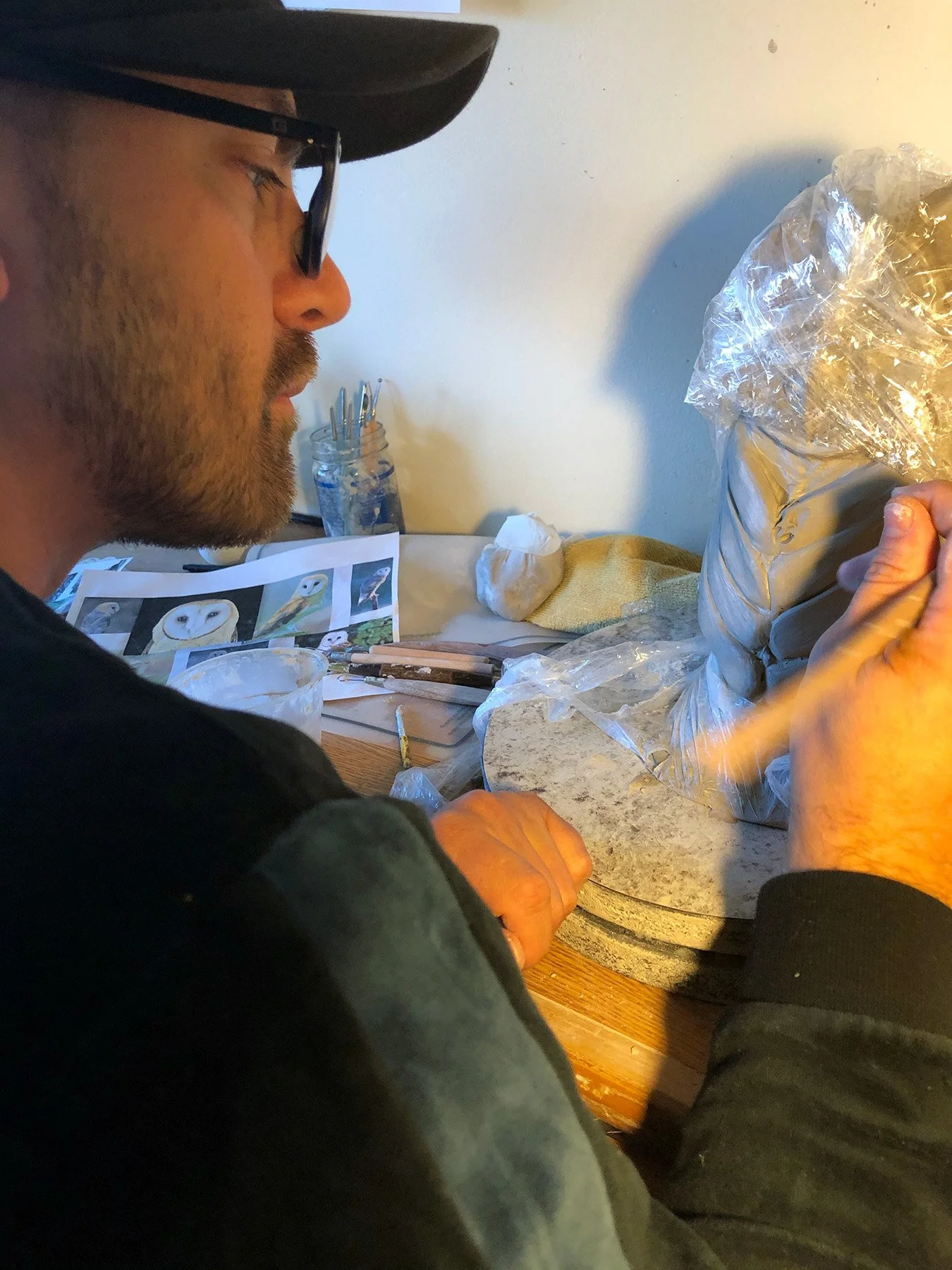
Ben Minnis: I'm doing great. Thank you so much, Brandi. I'm really excited to be here and chat with you and your audience about the essence of being human. I'm excited just to connect with you about this. Of course, I'll entertain any questions about my art, but I'm just happy to be talking to you.
Brandi Fleck: Awesome. Well, thanks.
Real quick, before we dive into the real meat of the episode, can you introduce yourself for our listeners? Give them some background info about who you are and what you do.
Ben Minnis: Sure. Well, my name is Ben Minnis. Good place to start.
I grew up in Des Moines, Iowa, raised in the Midwest, and I've lived out in Eugene, Oregon, for the last probably 16 years or so.
I always saw myself as an artist growing up. I certainly never thought about what job I was going to get or what I was going to become in that kind of context, but art was always present in my life.
Whenever somebody would ask me what I was going to become, from the time I was 8 to 16, I would always just say "rodeo clown," even though I never really, I didn't love the rodeo. I'm sure I would just get hurt. I like to entertain people, but I don't really listen to country music or watch the rodeo, so I figured I wouldn't fit.
I always just saw myself creating, and I never really thought about work until I finished school. Then there's no question about it. You have to think about it.
I went to school to be an actor and a director. That's kind of what I was totally focused on through the end part of high school and college. I was drawn to acting and directing because of that energy that takes place on stage, that vibrant electricity between the people on stage and the audience. That totally captured my attention and energy, and I focused on that for years.
Then by the time I finished school, I was looking for something a little different. I wasn't wanting to audition for my whole life. If somebody had offered me a job in Hollywood, I'm sure I would have taken it, but I dove into working with young kids for like 14 or 15 years.
I've been working with young kids, like really young, from infants through 3-year-olds, were my wheelhouse for years. I worked with them with materials. We had a material-heavy curriculum, so I was thinking with materials and kids for a long, long time.
Over the last few years, I started, in my own free time, just turning to clay as that kind of outlet, that release, and that fluid space away from work where I could just kind of be myself and explore myself. Now I'm diving in and doing it full time.
Brandi Fleck: Awesome.
When you say you worked with kids, were you a teacher? And when you mean materials, what did you do there?
Ben Minnis: Sure. Yes, I was a teacher. I was a teacher for probably nine years in a preschool setting at the University of Oregon.
Working with the 0-to-3 crowd, I wasn't burdened with them having to learn everything that I know. It was more about living as you learn and kind of living in the moment and facilitating kids' experiences together, their first experiences of the world.
Kids are built to learn and built to explore and experiment. For me, it was really about creating context and being kind of a co-explorer with them as opposed to an all-knowing teacher.
As far as materials, we worked with all materials. We viewed anything, wire, if you're engaging with leaves, clay, drawing, anything that has the potential to take shape from the thoughts of a child and through their hands has the ability to be a viable material for us.
Brandi Fleck: Well, that's really cool. I like how you sort of described yourself as a co-explorer.
Ben Minnis: It's kind of accepted within early childhood that life teaches you what you need to learn. As long as you face the challenges that are in front of you and work through them, life can be that simple.
Then as kids get older, it gets a little more complicated, and people think learning is kind of out of the scope of experience and firsthand information. But working with young kids, it's fully accepted that the life they're living is where the learning is coming from.
Brandi Fleck: That's interesting, and I bet that could apply in adulthood too, even though it's not as widely accepted.
Ben Minnis: Well, I sure hope so. That's how I'm approaching things, for sure.
Brandi Fleck: Okay, well on that note, how would you describe yourself as a person?
Ben Minnis: It's always tricky because sometimes you can go into describing how other people might describe you, so I'll try to avoid that.
I see myself as creative, curious, and compassionate. I'll try to stick with C's here.
My creativity and my curiosity have always been my guiding posts. I'm also silly. I like to just play with the possibilities of what's in front of me.
I describe myself as an introvert, even though the people I spend time with, that's not necessarily the first thing people think of when they see me. But when I'm alone, I'm at peace, and I don't seek company or distraction or diversion. I'm really most at peace when I'm alone or in my own thoughts.
That's part of why searching for a creative way to live my life is so important. I love being around people. When I'm actually with people, I love it, but the idea of it is always a little daunting. I always see myself as an introvert because I'm most drawn to those moments.
That's me in a bit of a nutshell.
Brandi Fleck: All right. Well, very good.
Let's dive a little bit deeper than that. Please tell us what inspires you in general.
Ben Minnis: Well, I'd say in general it's kind of a sense of connectedness.
For me, especially as far as inspiration in a creative realm, and even just in general, moments of silence in nature are my most clear moments of inspiration and when I feel the most fully connected to both myself and my surroundings.
It's that simplicity, that moment in nature when you can just watch a little ant diligently doing its business and suddenly realize the distance between yourself and that ant vanishes, and you can really empathize and see yourself in that routine struggle and process of being. That's what really inspires me, finding that, getting down to that essence of just being.
Brandi Fleck: Wow. That was really awesome, Ben. I hadn't thought about it like that. That's really cool, to empathize with other beings that are doing. Even though it's an ant, it can do things. It's in a routine just like we are. It does stuff like that. I can't even say the words, but it's awesome.
Ben Minnis: There's been times when I've been the most stressed and the most distant from just my animal instincts, when I get kind of contorted into the human world, where I remind myself, "Just be the ant." Be fully present and committed to that task that's right in front of you, and unburden yourself a little bit with the trappings that human thought can lead us toward.
Brandi Fleck: Yeah, that's really good advice, and that is a takeaway I will definitely put in the show notes for our listeners.
Ben Minnis: Cool. Be the ant.
The Meaning Behind Human Faces in Sculpture
Brandi Fleck: You've talked about connection inspiring you, and one of the main characteristics of your art is human faces. They all do sort of flow together and connect in ways, no matter what the piece is, what the functionality of it is, whether it's a sculpture. I know you've done gnomes, owls, you do vases, you've had lamps and clocks, but these human faces are all woven throughout.
Can you tell us a little bit about why the faces, and why the repetition with the faces?
Ben Minnis: Sure. I'll start really simply with how I came about that kind of approach.
It's really as simple as marking down what I see in the clay. As I've developed my work, I've seen a lot more intention in my approach, but it really started as a simple visual lesson of kind of messing up a bit of clay and seeing what I see in it, and making it reveal itself a little bit more.
I've likened it to if you see a cloud that almost looks like something. If you could just grab the cloud and smooth out those edges and make it look a little more like what you already see, that's generally how a lot of my work starts and where that leads me.
To faces, I just relentlessly see eyes and mouths and that basic symmetry of the face emerging from the clay all the time.
When I was a kid, it started because I saw faces in the swirls of bathroom tiles. Faces just revealed themselves in bathroom tiles and clouds and that stuff throughout my whole life.
Brandi Fleck: Yeah.
Ben Minnis: That's kind of the basic form that I see when I'm looking at clay, like a piece of earth.
I think back to my work with infants. From the second we're born, as soon as our eyes open and we're trying to make sense of the confusing chaos of the world around us, infants are built to look for that basic symmetry of the eyes and the mouth. They're meant to look for that face, Mom, from the second they're born.
That's the first thing out of the chaos of the world that makes sense to us, the thing we're meant to look for. I think it's humans.
When I'm working with clay, I kind of approach that same thing. I'm built to see faces in the abstract a little bit.
Brandi Fleck: Yeah. Very cool.
Ben Minnis: The repetition of faces comes from the fact that a lot of times I'll start a work, and I'll just keep turning it. Everything I see in it, I'll just keep wondering. If I see something, I'll mark it and highlight it.
A lot of those faces come from me just turning it and looking a little bit more. What might have started as one face's mouth, if I turn it, I can start to see the potential for that same opening to be an eye for another character. I'll start marking that piece out.
It's really about, mark by mark, observing and wondering about what I'm making and letting things keep developing.
Brandi Fleck: Awesome. It's sort of like an evolution.
Ben Minnis: Definitely.
Brandi Fleck: Okay, so that may answer this question, but why do you sometimes do full faces and then, at other times, do partial faces? Does that have any meaning in your work?
Ben Minnis: Sure. One thing I love about art and my process is that the meaning can evolve, and it certainly does evolve.
Sometimes I might start in a really fluid spot with just a piece of clay, a piece of earth, and I'm just moving. I'm in this back-and-forth space of wondering about where this might go.
Then, as things finalize, I'll have this finished form. I think humans are built to keep looking for meaning in, "What did I create? What is this here? What does this mean?" That's sometimes when I access those deeper metaphors in my work.
A lot of times I'm playing with the idea that if there's one key central face that has a lot of smaller faces kind of within it, behind it, or coming out of it, that's kind of playing with this idea that the central face is the thinker, and all these other faces reveal the other selves and thoughts and complicated bits within us.
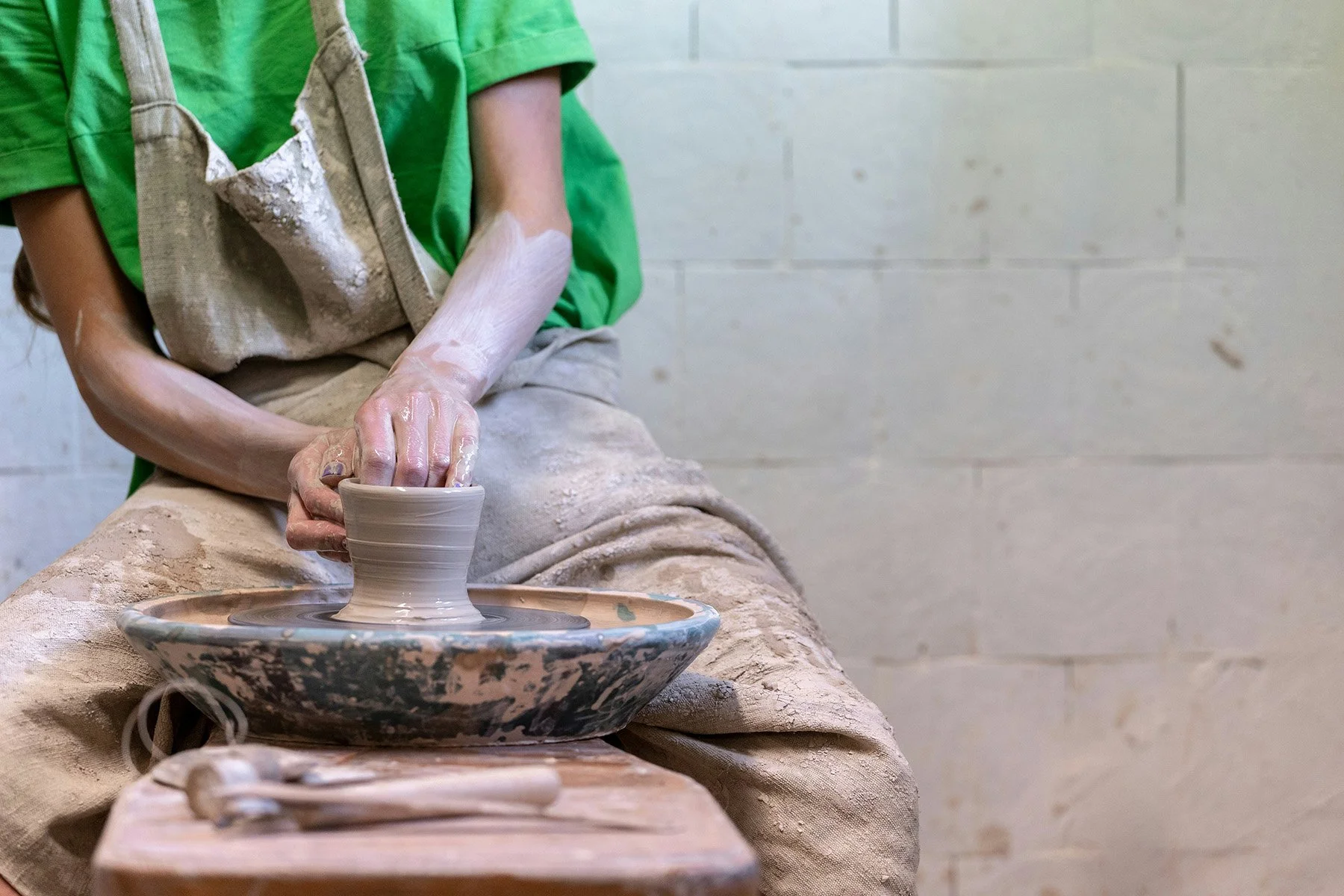
Sometimes I'm playing with the complicatedness of how one individual is really a combination of so many different complicated things.
Other times, I'm trying to show things like, I've sculpted the world and a lot of different full objects that are made out of a mosaic of a lot of people.
A lot of times that's more exploring the interconnectedness of us all and how the lines between us can kind of fade when we zoom out and realize our common struggle and our common experiences.
Brandi Fleck: I love it. That is awesome.
Ben Minnis: That's why sometimes the individual identity is kind of obscured, and it's the communal portraits that I kind of make.
Brandi Fleck: Yeah, I can totally relate to all of that. It's really interesting to hear how you're putting it into words and describing it.
I want to bring up, too, you recently posted a picture of this, it was like this head that had film coming out of the different eyes and projections.
Ben Minnis: Yep.
Brandi Fleck: Just tell us a little bit about that one. Can you describe it for us and tell us what's happening with the projections?
Ben Minnis: Yeah, for sure.
Well, it's basically a bust of a human from the shoulders up. The head, especially the back of the head, is all carved out with a bunch of different faces, weaving eyes and mouths.
The back has colored roots coming up into the back of the head. Inside all the eyes and mouths in the head are old slides. There's a lamp inside the head, so when the light is turned on, you see images of people, places, maps, old artwork.
It's kind of meant to show, when the light's turned on, the rich tapestry of experiences and thoughts and wonderings that make us who we are.
When the light's off, it's just this flat, white porcelain person. But when you turn it on, the vibrancy of what's inside and the result of all that mix of experiences becomes us.

Suddenly you have this colorful, vibrant person, whereas before the light was turned on, it was just this kind of cold, sterile bust, kind of classic looking. That's kind of where I was thinking with that one.
Brandi Fleck: Gotcha. That's really cool, too.
It reminds me of something somebody else had said on the show, that if you dive deeper into a person's story and get to know them, it's a lot easier to see them as a person and not just a face or somebody that you don't know.
It's almost like if you took the time to learn somebody's story, you would realize what they've been through, and you could show more compassion and things like that. It reminds me of that.
The colored roots that you talk about also remind me of wires. Are you saying anything about our technology and our information-age society at all?
Ben Minnis: I wasn't consciously.
I have a couple other ones that I've kind of played with, that idea of technology and the person. I've made one that's just called Dumb Phone. It's kind of like a smartphone, but all the little apps on the screen are these lonely faces, lost-looking faces.
Art as a Reflection of the Human Experience
Brandi Fleck: I totally see, as soon as you said the wires, I viewed it almost more as roots, those kind of deeper things within us under the skin that are kind of going up into the brain. But I love that play on technology, for sure.
Ben Minnis: Okay. That's one of the beautiful things about art. If it leads your thinking somewhere, it's on the right course.
Brandi Fleck: Right.
Ben Minnis: Even if it inspires you to think about metaphors of technology and the self, the point is to be thinking.
Brandi Fleck: Absolutely.
What piece do you have that most closely represents your own humanity?
Ben Minnis: I would say it's probably a little figurine I built that I call Three Sides to Every Sucker.
It's kind of a little figurine where there are front and back faces, with a bunch of little thoughts and things coming out of the top of the head. The front figure is a little person holding a sucker in their chest, and in the back there's somebody in the same place where the sucker was, but it's a hole in their chest. Then, kind of in between the two faces, is this kind of lost, unsure face.
It was something I created in kind of a flurry, but then as I was finishing it and glazing it, it's a piece that really made me just keep thinking.
I really started to think about how the things that, at times, on some levels, are the things we hold so dear and sweet... In the back of that same piece, those same things can leave us empty-hearted and feeling hollow.
This kind of face in between is kind of stuck between this perfect image of things and this horrible image of things. The in-between face is kind of where we all actually reside, where things aren't as simple and sweet as a sucker, and things aren't as horrible and tragic as an empty heart. We're kind of stuck there in the middle.
That's the piece that I kind of keep thinking about.
Brandi Fleck: Gotcha. Okay, well that's interesting.
Overcoming a Stutter Through Creativity and Self-Expression
So our listeners can relate to you on that level, can we back up a little bit and have you tell us your life story? I know that's big.
Ben Minnis: Sure. Yeah, my life story.
Like I said, I grew up in the Midwest. I grew up in Des Moines and had a totally normal childhood and all that. But I definitely had a period in middle school where all my friends from elementary school went to a different school than I did.
I feel like I stayed the same person, but I had way less connection. I was way more on my own. All my friends were gone, and I didn't really make new close friends for probably five years.
I had this big period in my life where I had a lot of acquaintances at school. I'd be silly and stuff like that, but I also had a lot of rich time at home and on the weekends where I really just fed this inner self by painting and creating and, of course, just getting lost in music.
I felt like having this period in my life, which is really a rich social period for a lot of people, but for me it was less so, I really developed a rich inner compass. I really learned myself in that period.
At the same time, I had a major stutter from grade school until I was 16. You've known me for a while. You probably didn't know I had a major stutter.
Brandi Fleck: No, I didn't know that.
Ben Minnis: Yeah. I was in speech therapy for years and years. It's one of those wildly debilitating things where the fear is just constant of having to speak or getting called on.
I would always craft any sentence I was going to say. I'd craft it in my head to make sure I avoided specific consonants or vowels that would make me stutter. I got really quick at running through all these options of how I was going to say things in my head before I would say anything because I was so nervous about people laughing and all of that stuff.
The thing that actually really got me over it was somebody convinced me to do a full-length improv show in high school, which sounds like the antithesis of a good idea.
I plowed through that, and I didn't have a single thought process of being nervous about what I was going to say or, "Am I going to stutter?" I didn't even have that thought process while I was on stage, let alone did I stutter.
That was a confidence builder for sure, and it definitely stepped me in the direction of exploring theater for years because I found something in myself that I had always been so inhibited about.
I found in theater a way to really be out there. Then eventually I got less focused on, "I need to be out there. I need people to see me," and became less exhibitionist.
Like I said, I slowly moved into working with young kids. I've been doing that for 15 or 16 years, and I found so much more than I ever was looking for. I was just looking to get paid to live in the moment, and I found this really rich way to contribute to and gain from community.
That's been a beautiful thing.
This year, we've always had a policy where you can take a year off and get your job back. I decided, "I'm going to take a year off and see how far the sculpting thing can take me and open myself up to the mystery in the future a little bit."
Brandi Fleck: Yeah, that is really brave. I just think it's courageous, and I admire that.
Ben Minnis: Well, thank you. It still might be a bad idea. I don't know.
Brandi Fleck: I mean, I feel like you're doing a great job. I'd love to check in later and see how it's going, too.
Real quick, when you did the first improv event, were you surprised that you didn't stutter?
Ben Minnis: Yeah. I'd always been silly. I'd always had a little bit of a class clown side where I could sit there and craft a little joke in my head and then say it out loud with confidence and kind of slink back into my little shell.
I knew I could be funny in front of people, but yeah, I was definitely nervous.
Somehow, this idea of performing kind of pulled up my bootstraps a little bit. I was more nervous to sit in math class and get called on to read out a word problem than I was to go up on stage.
Brandi Fleck: Yeah. There's something about just diving in. It can take you 10 minutes to get into a hot tub if you're anxious. Every little inch you put in can feel torturous, or you can just dive right in and be like, "Oof, this is nice."
Okay, and I don't know much about stutters, but I would like to know what causes it and what makes it go away. What's behind that?
Ben Minnis: Well, that's probably above my pay grade a little bit as far as having the answers for that, so I don't want to speak for all stutterers.
The experience of it for me was definitely a disconnect between the rapid firing within my brain and how fluidly that came out of my mouth. That was really the issue.
My thoughts were always almost overly complicated and quick. Whatever part of my brain would throw it into verbal language would get held up a little bit.
Like I said, I don't know all the specifics about why and how, but that's definitely the way it felt.
A lot of speech therapy is about slowing down, trying not to be nervous, breathing, and breathing into the words and stuff like that. I was in therapy for years, and that stuff did help a little bit.
It wasn't until I fundamentally found a way to put myself in a situation where stuttering didn't even feel like an option. I don't know what it was, because it literally pretty much stopped there. I still catch myself a little bit here and there, but nothing like the true stutter I had.
For me, it's hard to know what came first because sometimes it can be about nerves, but then if you stutter and you're afraid of people making fun of you, that makes you more nervous. It's kind of a self-fulfilling prophecy or a cycle.
For me, it was really about finding some way to come to peace with letting my inner world really just be out there also and not trying to hold it back or edit it or anything like that.
Once I was in that spot where I had the confidence to be like, "Everything on my mind, I'm going to throw it out to you right now," and then when that worked, I thought, "Okay, I'll do that a lot."
Brandi Fleck: Oh, that makes sense. Well, thank you for explaining that to us.
What about your journey got you to the point of deciding you wanted to take a year-long sabbatical?
Ben Minnis: Sure. I guess sabbatical is the right word there.
I think, on some levels, a sabbatical might be a paid venture. If that's the case, I'm not on a sabbatical. But yes, it's pretty much a sabbatical.
What got me to this point? Like I said, I was always a creator first. I always took tons of art classes, whether it was painting, drawing, jewelry, all that stuff, and then diving into theater.
I never thought it was something that I had to do or had to make money at. I knew I was going to be doing it, but I never felt like I had to find a career for it.
I went to school for it, but it wasn't until I was done with school that I really realized this was supposed to be about jobs and it wasn't just theater camp.
Like I said, I've been working with kids for the last 15 years or more, and more and more I started turning toward feeling this need to create, a need to focus on creating more than just on the side when I could get an unstressed moment away from work.
I wanted to reorient myself more fundamentally as a creator first. In my work for the last eight years, I've been an administrator at the school, so I'd become more of a manager of things than a creator of things.
Brandi Fleck: Gotcha.
Ben Minnis: I think, at this point in my life, I needed to give it a shot. I realized I'd never actually put myself out there to see if I could make a living on my creativity, make a living on the things I can generate with my brain and hands.
So I'm trying.
Brandi Fleck: Awesome.
On your website, you've described your artistic process as a conversation with the clay. You sort of talked about that earlier, that you discover as you go and it's an evolution.
Can you tell us in more detail how a conversation would go? For example, what do you think and feel as you're discovering what needs to come next?
Ben Minnis: Yeah. That process of discovery and feeling and wondering, for me, I want to keep that alive the whole time I'm working on a piece. That's what keeps it interesting because I'm wondering what's going to happen next the whole time I'm working on a piece.
As far as the dialogue, it can kind of start both ways.
When I first started sculpting, the conversation would always start from the clay. I would literally just grab a piece, mess it up with my hands, make it so it's full of bumps and weird pieces, and just turn it until I saw something.
Once I saw something, like I said, I would try to clarify that in the clay a little bit and solidify what I was seeing.
Then I would step back a little bit and be like, "Okay, so now what? Now what is the clay telling me? Now what do I see?"
That's the kind of dialogue.
Why Creative Expression Is Essential to Being Human
Ben Minnis: Listening to the clay, then acting a little bit, then listening. Each step, my actions are dependent upon what the clay is doing and what I'm seeing in the clay.
There are other times I'll kind of do the opposite. Just today I sculpted a duck because I was out on a hike the other day and saw the profile of this duck, and it totally looked like a face within the side of the duck. That kind of inspired me.
In that way, I threw the first pitch. I took a big chunk of clay and thought, "I'm going to work on a duck." I made this big basic form, but then I looked at it. I threw the first pitch, or the first start of the conversation, like, "You're going to be a duck, clay." Then it showed me, based on all the little bumps and movements, I started seeing things in it, and then the dialogue back and forth started.
Sometimes I'll start the dialogue and kind of force my ideas upon the clay at first, and other times it's not like that at all.
I can't start a piece and have it inch by inch defined as, "This is exactly what it's got to be," because then, for myself, that takes me out of this fluid process. Then I'm just trying to pigeonhole it and contort it into something. I'm chasing some old idea I had instead of living in the moment with, "What am I seeing? What am I feeling right now?"
Brandi Fleck: Awesome. That totally makes sense and connects to everything else you've said. It sounds to me like you try to keep that sense of wonder alive as you're creating.
Ben Minnis: Yep. That's what it's all about.
Brandi Fleck: Okay. So what about the concept of creation and creating? What does it do for you?
Ben Minnis: For me, it's those moments of creation. Those are the moments when I feel most fully in the present, where all my thoughts and intentions completely merge into the now, and they're required. I'm not just present watching what's happening, but they're fully engaged in the process of happening and in this discovery of what will be.
Basically, the concept of creation is it for me. It's the act of creating. Once a piece is done, I'm done with it. It's a process that I've engaged in, and once I keep turning a piece and I don't see anything else, it doesn't give me any more ideas for where else to go, it's done. That's how I know a piece is done, when it doesn't tell me anything else.
Brandi Fleck: Gotcha. So what do you think art does for your specific customers?
Ben Minnis: Hopefully it brings a piece of beauty and wonder and thoughtfulness into their homes.
I hope the people who have my sculptures in their homes don't see them as just, "There it is. It's a pretty little thing on the shelf." I'm hoping it catches their eye, that they keep looking at it, keep seeing new things, and keep wondering about how these faces are working together or how this thing happened.
For me, I hope it's a point of curiosity and wonder in the house, and hopefully something that resonates with them and their experience of the world and how things are connected.
Brandi Fleck: So what do you think art does for the human condition as a whole?
Ben Minnis: I think art gives us the ability to step back, to synthesize the things that we've been experiencing or wondering about, or the things that we're confused by.
Art gives us that subjective playing field to really process this experience that we're having and not just move straight through this experience from birth through death. Art gives us the opportunity to really slow down and to pass that experience through material languages.
The Reggio Emilia Approach and the Hundred Languages of Children
Brandi Fleck: Ooh, material languages. That's an interesting concept.
Ben Minnis: I'll admit, material languages and the dialogue are both concepts that are really heavily steeped in the early childhood philosophy that I worked in for the last few years, which was inspired by the Reggio Emilia approach.
Brandi Fleck: Okay.
Ben Minnis: It's an approach in a small town in Italy for infant, toddler, and preschool care. That's a whole podcast in itself, so don't get me started because I have talked about that for a long time.
Materials and artistic languages are really central to that.
There's a poem called The Hundred Languages of Children, and in that, Loris Malaguzzi, who's pretty much the founder of this approach, put this poem out there as kind of a powerful political message from the voices of children, saying that children can think and understand in hundreds of languages.
I don't mean verbal language. Verbal language is just one.
They kind of equate the language of wire, the language of clay, the language of dance, the language of movement, the language of drawing, verbal language, mathematical language. Those are all kind of the fonts of knowledge, ways of knowing, and ways of expressing.
We really put all those different languages on an even playing field. Reading and writing are right along with collage and sculpture and movement as ways of understanding the world.
Brandi Fleck: That makes a lot of sense. It's a more holistic way to learn.
Ben Minnis: Each language just has its own qualities.
Let's say you're trying to communicate your thoughts about love, kind of a generic topic. If you're going to write a poem, that's one way. But if you could only use movement, you'd access totally different aspects of what love means to you.
Not ideas you already had in your head. As you're actually moving, trying to communicate love, you'll stumble upon something.
On the other hand, if you had just a hunk of clay and you had the same mandate to think about love, to communicate love through this earth, the qualities of love that you end up communicating are going to be totally different than what you wrote in your poem and what you expressed in your dance.
Each language really has its own ability to help you understand and help you communicate that understanding.
Brandi Fleck: Yeah, that's awesome.
Ben Minnis: My work with early childhood has totally inspired my thinking as an artist, for sure.
Brandi Fleck: Gotcha. So are there any other things you've observed about art or materials from that early childhood teaching context?
Ben Minnis: Yeah. I just feel like it's such a natural part of childhood to take the object that's right in front of you and decode it and explore its potential, and to express everything within your little soul and spirit through those things.
Ben Minnis: It comes really naturally for children unless they get messages that it's unwanted and inappropriate. Then inhibition starts creeping in.
For me, children all know they can sing. They all know they can move. It's external ideas or messages that they get that kind of limit the languages they can use to the point where they feel like all they can do is reading, writing, and arithmetic. All the other languages that are part of the human condition don't get fed and nourished.
I think kids flourish in a context where they're encouraged to use all their capacities for knowing and wondering about the world. That's why we always flood them with materials, because we know each material they have exposure to gives them a chance to learn something new about themselves and their surroundings.
Just imagine what it would be like if that never stopped and we just had a world full of people who didn't have inhibitions about those different types of languages and expression.
Brandi Fleck: Oh, 100%.
Ben Minnis: If you go to Reggio-inspired conferences, you see thousands of early childhood teachers who themselves have been so deprived of that.
The material workshops, which are really supposed to be about thinking about how kids experience materials, these teachers just absorb it. They didn't get their fix. They were taught out of those languages, and suddenly when that's offered to them, you see people flourish in these languages.
People who would say, "I'm not comfortable with collage," if you're in a room full of people with random materials in their hands who are thinking and creating, suddenly it becomes, "Actually, this is okay. I can do this."
I think it's part of the human condition. Like I said, for kids it's natural. Learning through life, expressing through life, being in touch with your emotions, and seeking connection from others, that's so natural for young kids. It's just one of the many things that we obscure as we get older.
Brandi Fleck: Yeah, so true.
What Creativity Teaches Us About Ourselves
Do you learn new things about yourself when you create a sculpture? If so, what are some of those things that you've learned?
Ben Minnis: Definitely.
A lot of it is kind of like what I was describing when I talked about Three Sides to Every Sucker. There's some part of it where, when I finish a piece, because the creation is such a fluid process, and I reflect on it, it's like solo therapy a little bit. It's like, "Wow, that was in my brain, and it came so readily out into that clay."
Sometimes I think about myself. When I talk about my work demonstrating the interconnectedness of people, the shared identities, and the richness of our own singular identities, the more I work in it, the more those thought processes are at the tip of my mind as I'm working.
It started as something I recognized in my work, and now it's something that I more consciously explore while I'm creating.
Building a Career as a Contemporary Ceramic Artist
Brandi Fleck: All right. Well, I'm sure everybody wants to know, please tell us where people can find you and your artwork.
Ben Minnis: Sure.
An easy one is Instagram. I'm @huminnistsculpture. I'll spell it out for you because, sadly, I'm an addict for puns, so I couldn't help but use my last name, Minnis, in my website and all that stuff.
I also have a website that has most of my sculptures on it. You can get to that from the Huminnist Sculpture Instagram. There's a link.
My full website is huminnistsculpture.wordpress.com.
Please check that out. Like I said, Instagram is a little easier to find, and my website is linked from there.
I've got a lot of current sculptures that are available, but I've also been doing a lot of custom sculptures for people. I love talking with people if they've got an idea of something that's important to them or their family, or somebody in their family is getting married.
I love thinking with people about how to make a physical, three-dimensional object that might memorialize something that's important to them or somebody who's close to them.
Brandi Fleck: Gotcha. So you are definitely open for commissions.
Ben Minnis: Yeah, of course.
Like I said, I love being in the dialogue on my own, but when I've had those times where somebody else throws the first part of the dialogue, throws the first pitch, and that sets my mind on a creative dialogue with the clay, I really love that too, for sure.
Brandi Fleck: Awesome. And where all do you ship? Is it the United States, or can you ship anywhere?
Ben Minnis: If you really want it, I'll find a way.
So far, I've only shipped around the U.S. I haven't shipped outside the U.S., but that's not a bad problem to have if I have to try to figure that out.
Brandi Fleck: Awesome.
Okay, and then last but not least, can you leave us with some parting wisdom? Just tell us, what's the best piece of advice you have for our listeners?
Ben Minnis: Parting thoughts are easier because then you can decide if they're wise or not.
I guess I'd say, wander toward your wonder.
That's definitely a process I'm on right now, where I'm trying to move toward the things that make me curious and make me wonder, trying to be comfortable with not being on a solid, clear path, and letting myself wander toward that wonder.
I'm sure it'll continue to bear some fruit.
Brandi Fleck: Awesome.
Well, Ben, it has been an absolute pleasure talking to you today, and I just want to thank you so much for coming on the show.
Ben Minnis: Oh, no problem, Brandi. It's great talking to you, too. Thank you so much.
Join the conversation!
Feel free to share your own experience and let me know if you have any questions in the comments.
Related Posts





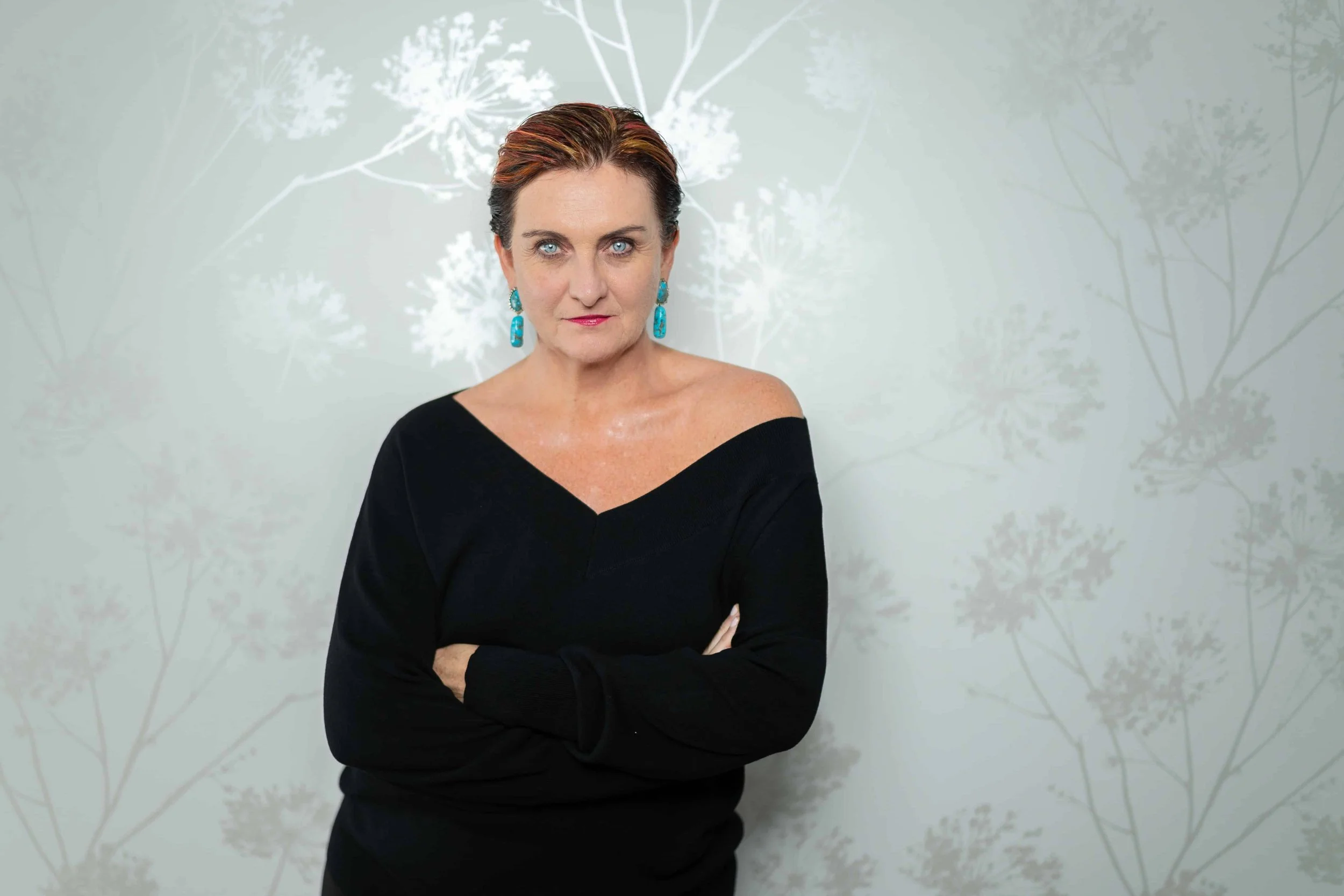
Hi, I’m the founder of Human Amplified. I’m Brandi Fleck, a recognized communications and interviewing expert, a writer, an artist, and a private practice, certified trauma-informed life coach and Reiki healer. No matter how you interact with me, I help you tell and change your story so you can feel more like yourself. So welcome!
Find More on the Blog
Topic
- ADHD
- AI
- Atlanta
- Black and BIPOC
- DIY
- FAQ
- LGBTQIA plus
- Los Angeles
- Nashville
- Seattle
- St Louis
- St. Louis
- UFOS/UAPs/ETs
- abuse
- accountability
- addiction and recovery
- adoption
- affirmations
- afterlife
- altered state
- angels
- animals
- anxiety management
- art
- astrology
- atlanta
- attachment
- awakening
- beauty
- behind the scenes
- being human
- body image
- body work
- boundaries
- brandi fleck
- breathwork
- bullying
- burn out
- burnout
- cancer
- career
- caretaking
- chakras
- channeled
- clarity-dive
- clarity-practice
- clarity-primer
- clean products
- coach
- codependency
Recent Blog Posts
Visit the Full Podcast Audio Archive

Affiliate


7 simple ways art can instantly inspire you when life feels flat. From beauty to courage, these quick jolts reconnect you to meaning, joy, and creative spark.